
Managing Token Allowances
Key Takeaways
Introduction
DeFi grants users control over their assets, including their private keys, offering unprecedented sovereignty and authority over their funds. However, with great power comes greater responsibility, requiring users to take full charge of the safety and management of their assets.
There are four common categories of scams that DeFi users should be aware of:
-
Seed Phrase Compromise: Attackers attempt to deceive users into revealing their seed phrases, which would give them unauthorized access to funds. With your seed phrase, an attacker can drain all your funds and continue doing so if you deposit additional funds into the wallet. Unfortunately, there is no way to recover from this situation, and the only solution is to create a completely new wallet with a new
seed phrase. -
Direct ETH Transfers: Scammers can conceal ETH transfers by disguising them as a function call, such as “Security Update.” The raw signature method behind older versions of this scam has been removed from MetaMask; modern phishing kits instead abuse ordinary-looking signature requests, counting on you to sign without reading what your wallet displays. Falling for this scam means you won’t be able to recover your funds, but you can still safely use your wallet for other transactions.
-
NFT Marketplace Listings: Be cautious of fake listings and malicious contracts that exploit the allowances you grant to marketplaces like OpenSea. Scammers may trick you into signing an
offchainmessage that lists your approvedNFTsfor sale, with no actual token transaction taking place. -
Token Allowances: Attackers may manipulate permissions to gain access to more funds than initially approved. “Approvals” are on-chain transactions that grant access to your tokens or NFTs. “Permits” offer the same access but only require a gasless offchain signature. Uniswap and most modern trading apps use this system (called Permit2). Permit signatures don’t appear as onchain approvals until they are used, and can carry expiration dates; Revoke.cash’s “Signatures” view lets you check and cancel them.
As smart contracts gain popularity,
token allowancesbecome necessary to enable trusted contracts to execute transactions without exposing private keys. Token allowances allow dApps to automatically move tokens in your wallet on your behalf. While this convenience boosts efficiency, it also exposes users to potential attack vectors through scams and unauthorized access.
In this article, we’ll discuss ‘Token Allowances’ and introduce a community tool built to help manage your permissions.
Token Allowances: Understanding, Managing, and Ensuring Safety
Token allowances are permissions given in advance to smart contracts to spend tokens from a wallet. They serve a crucial role in facilitating transactions without requiring explicit permission every time for direct asset transfers from the wallet. When misused, however, token allowances can become an attack vector for the unsuspecting. To address this risk, it’s important that DeFi users exercise caution, educate themselves on the security landscape, and understand how token allowances actually work.
There are two steps involved when granting permissions to a third-party contract:
-
Wallet connection: When connecting your wallet to a dApp, you simply share your wallet
addresswith its front-end, letting it display your balances and activity. Connecting grants no onchain permissions by itself. -
Token approval: To transact with the dApp, you then approve its smart contract to move specific tokens on your behalf. This is the step that grants real spending power.
By proactively managing token allowances, users can ensure that no contract withdraws more than the initially specified amount from their wallet. Luckily, there are community tools built to help give DeFi users confidence and peace of mind.
Walkthrough: Using Revoke.cash
Revoke.cash empowers users to easily manage their token allowances through a simple website that helps inspect and monitor allowances given to different dApps. Let’s walkthrough how you can use this powerful community tool to help you safeguard your assets and take back control of your wallet.
1. Connect your wallet:
To begin the process of revoking your token allowances, head to Revoke.cash and click on “Connect Wallet” located in the top-right corner. Alternatively, you can manually enter your wallet public address in the search bar. Once the loading is complete, you’ll see a list of all your token approvals on that network.
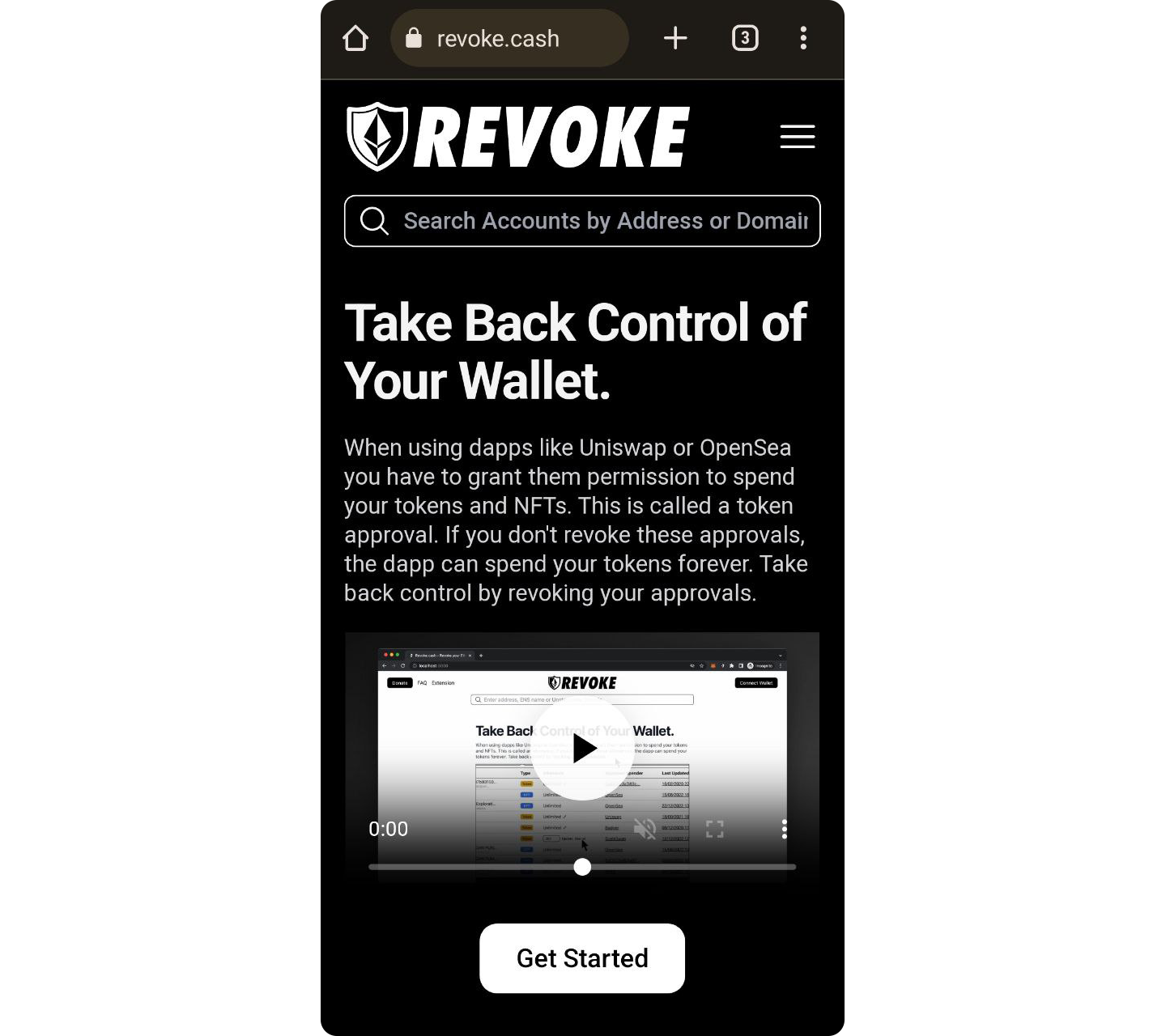
2. Inspect your allowances:
Once you have connected your wallet, you can inspect your existing approvals. You can sort, filter, or search for specific approvals based on the authorized spender address. Sorting by “Newest to Oldest” is particularly useful if you suspect a malicious approval recently. Use the sorting and filtering options provided to gain an overview of the token allowances you have granted. Allowances are granted per chain, so use the network selection to repeat the review on each network you use.
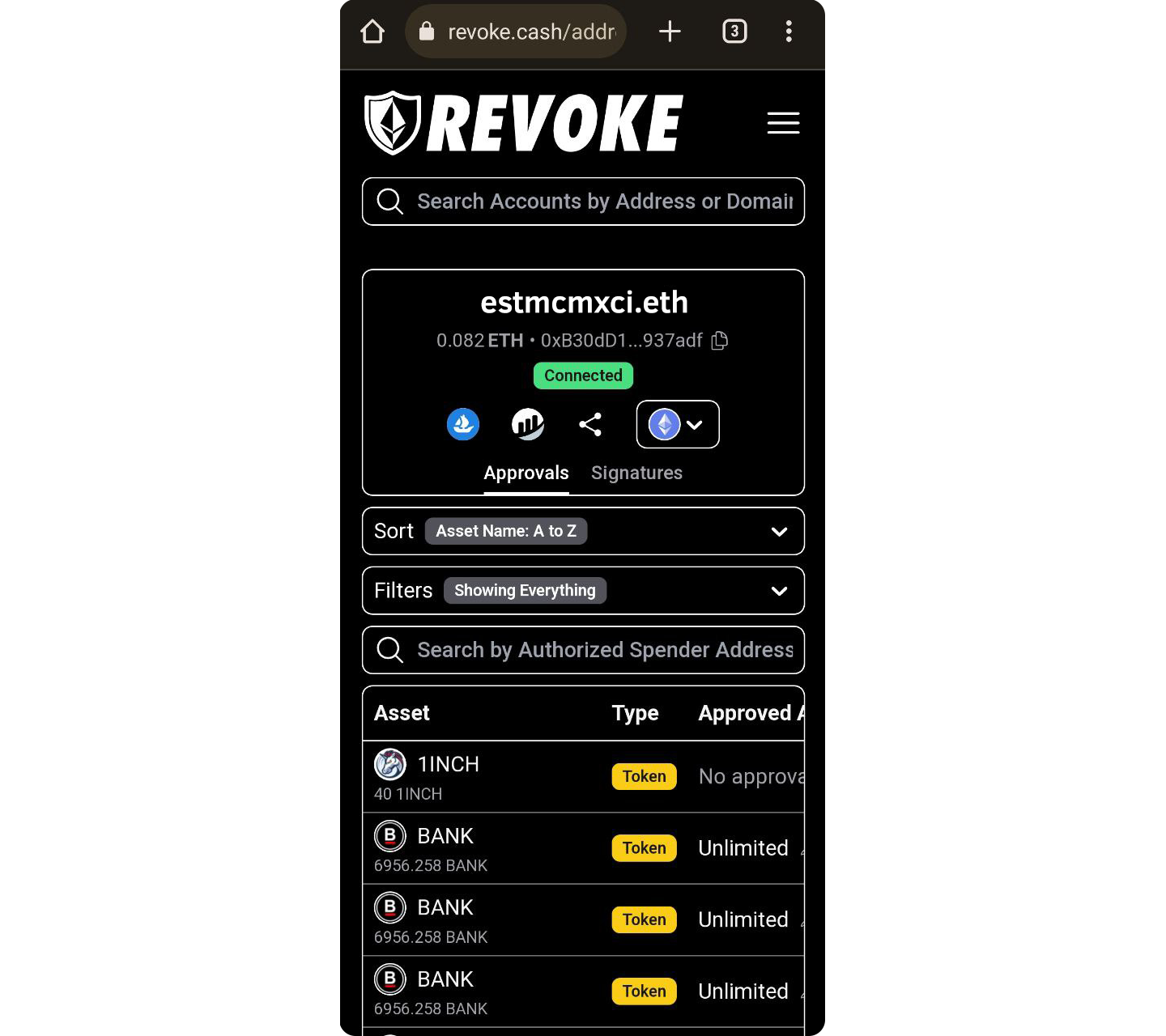
3. Revoke undesired allowances:
Once you identify the approvals you want to revoke, simply click the “Revoke” button next to each of them. Optionally, you can update the approval to a different amount by clicking the pencil icon next to the approved amount if you still require the approval in the future but wish to reduce your risk.
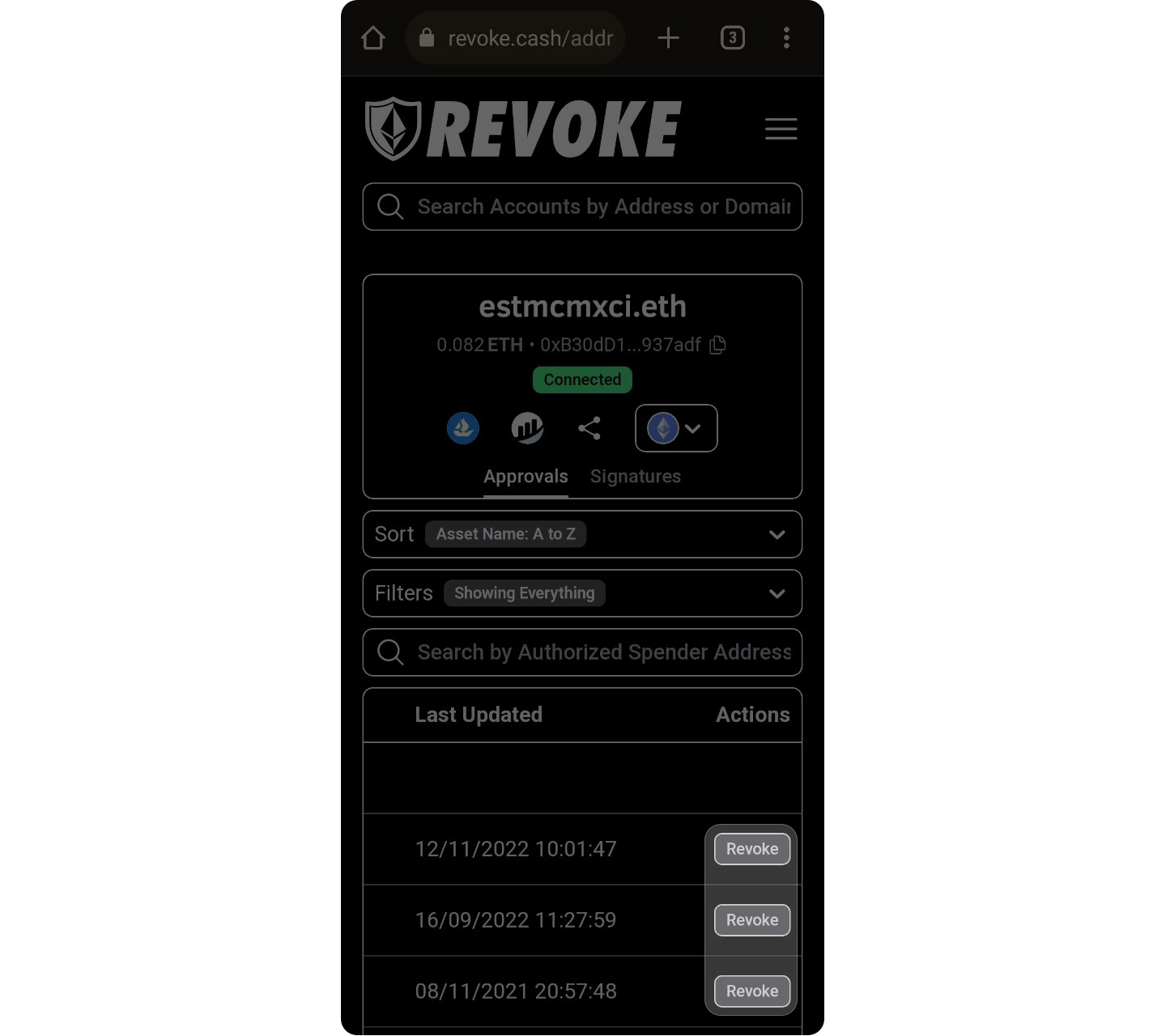
It might be in your best interest to revoke or adjust a token allowance if:
-
A recently deployed smart contract is exploited and creates a vulnerability in a
decentralized exchangeyou regularly use.In April 2023, popular
DEXSushiSwap suffered a similar exploit, when ~$3.5M was stolen from users. Affected users remained at risk if they hadn’t revoked their token allowance. -
A malicious governance proposal updates several contracts with the intent of draining users’ funds.
More than $2.5M in assets were compromised when Atlantis Loans, a
DeFiprotocol on a BNB chain, executed a governance proposal that targeted several contracts. Users who managed their approval limit mitigated the risk of their wallets being fully drained by the malicious proposal.
Don’t Forget Delegations
Since Ethereum’s Pectra upgrade (May 2025), allowances aren’t the only permission worth reviewing. A newer wallet feature (EIP-7702) lets your wallet delegate to extra code, enabling conveniences like transaction batching, but also a new drainer trick: a single malicious signature can install “sweeper” code that instantly forwards anything you deposit to an attacker, without your seed phrase ever being exposed. In 2025, researchers at Wintermute found that over 97% of early wallet delegations pointed to identical sweeper code.
Revoke.cash shows your active delegations under the “Delegations” tab, but because delegations are controlled by your wallet rather than by dApps, you revoke an unwanted delegation from inside your wallet itself. In MetaMask, open the account details and switch the account back to a standard account. If you never chose to upgrade to a smart account, treat any delegation you find as hostile.
It’s time to strengthen our wallet defenses! We hope you’ve enjoyed this entry in the Explorer’s Handbook: ‘Managing Token Allowances’.
Don’t forget to collect this entry if you want to own a copy for easy reference on your travels, or to support future content at Bankless Academy. Safe travels, Explorer!
FAQ
When should I use Revoke.cash?
Use Revoke.cash periodically, especially during periods when you are not actively using a dApp, particularly for NFT marketplaces. Limiting approvals lessens the risk of funds loss due to hacks, exploits, or phishing scams. By sorting your approvals to show the most recent, you can identify the suspicious approvals and revoke them promptly, mitigating further damage.
Does disconnecting my wallet protect me from approval exploits?
Disconnecting your wallet from a dApp does not protect you from exploits, approvals or otherwise. The token approvals you previously granted remain active even after disconnecting, because they are stored onchain.
How can I avoid token allowance exploits and similar risks?
A proactive approach to token allowances includes:
-
granting allowances only to trusted dApps.
-
periodically reviewing token allowances.
-
removing unnecessary or suspicious allowances.
-
checking for wallet delegations you don’t recognize.
-
staying informed about dApps’ security updates.
Consider using third-party tools like the Revoke.cash browser extension: it acts as a proactive measure against potential threats. The extension warns you if you are about to sign something potentially harmful, protecting you from phishing scams or other malicious activities.
Can I recover funds with Revoke.cash?
Unfortunately, Revoke.cash cannot recover stolen funds. It serves as a preventive tool to reduce the likelihood of becoming a victim of approval exploits. However, revoking the approvals used to steal your funds can prevent further theft.
Why does my wallet keep getting drained each time I top it up?
Your wallet may contain a “sweeper bot,” a script that watches a compromised wallet and rapidly transfers any new deposits out before you can act. One cause is a compromised seed phrase. In that case, revoking approvals won’t help; abandon the wallet and create a new one. But a malicious wallet delegation is an equally likely cause: sweeper code installed through a signature you were tricked into providing, without your seed phrase leaking. Check the “Delegations” tab on Revoke.cash. If you find a delegation you don’t recognize, revoke it from inside your wallet (e.g. via MetaMask’s account details). If there is no delegation and the draining continues, assume your seed phrase is compromised and move to a fresh wallet.
Author
Marcus publishes the ENS DAO Newsletter. He researches how surplus revenue generated from protocol fees can subsidize application layer development and other open source infrastructure.
Editors
Tetranome is the Project Champion at Bankless Academy, focusing on user experience, interface, design, and content.
Trewkat is a writer and editor at BanklessDAO. She’s interested in learning about crypto and NFTs, with a particular focus on how best to communicate this knowledge to others.
Patron
This unsponsored article is part of your free Bankless Academy education. Collect the article to support future content!