
Understanding Stablecoins
Key Takeaways
Why Hold Stablecoins?
Stablecoins have become a cornerstone of the DeFi ecosystem. After reaching roughly $140 billion USD in supply at their 2022 peak (pictured below), total supply passed $300 billion in 2026, and stablecoins settled over $30 trillion in transaction value in 2025, more than Visa processed that year.
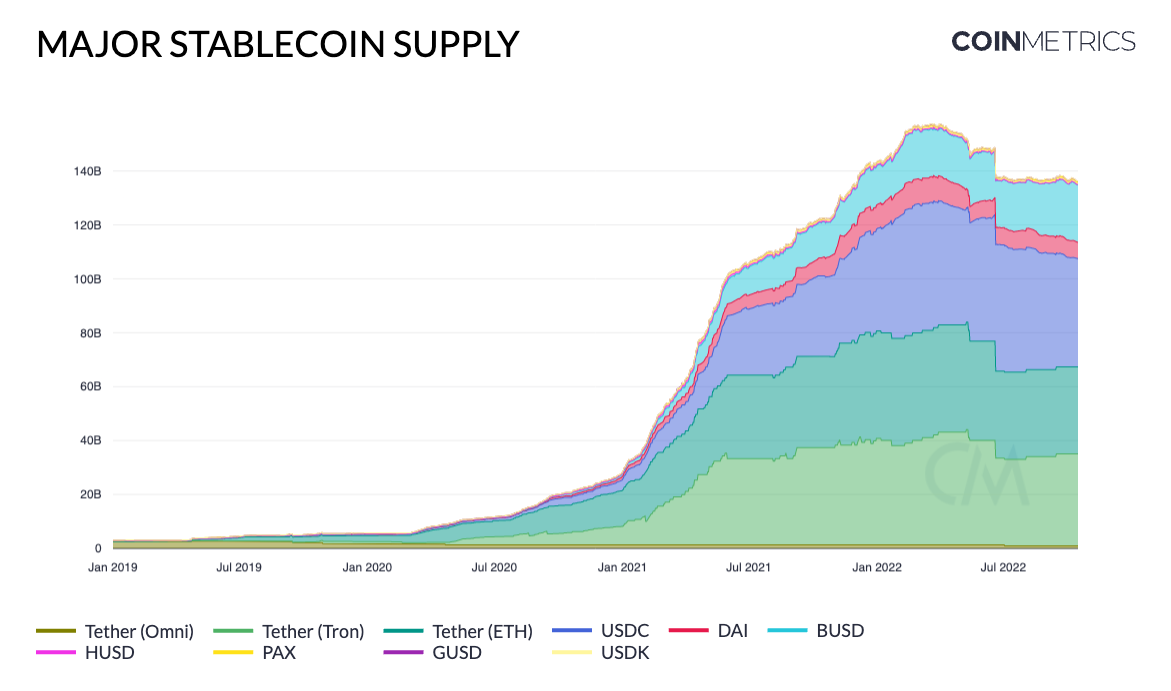
Here’s why they’re in demand:
-
Stability: Holding stablecoins in your self-custody wallet is like holding fiat currency, but on the blockchain. When holding a stablecoin like USD Coin (USDC), issued by Circle, you can expect it to maintain 1:1 value with the U.S. dollar while the prices of assets like ether and bitcoin fluctuate.
-
Flexibility: Because this pegged value exists as a token on the blockchain, it’s easy to move between fiat value and crypto value.
-
Access: Stablecoins provide access to a range of decentralized financial services, like permissionless borrowing or lending to earn interest.
-
Security: Cryptography makes it extremely difficult for attackers to capture or forge transactions.
The way a stablecoin maintains a 1:1 equivalence, or peg, to its fiat counterpart is its most important property. Just as fiat currency is only worth the fundamentals that underlie it, a stablecoin peg mechanism dictates the value of your holdings.
Stablecoin Categories
There are three common strategies for a stablecoin to maintain its price peg:
-
💵 Fiat-backed: 1:1 collateralized by real-world fiat reserves.
-
🔗 Crypto-collateralized: overcollateralized by crypto deposits into DeFi protocols.
-
🔃 Algorithmic: supply-balancing algorithms in place of full collateral, a design with a troubled history.
1. Fiat-backed Stablecoins
Fiat-backed stablecoins maintain value by issuing a fixed token supply matched by real-world currency reserves. Their on-chain price is maintained via supply/demand economics: few people want to pay more than one real-world dollar for a dollar of on-chain value, so they simply take their trade elsewhere. To meet increased demand, the stablecoin issuer locks up additional fiat and increases the token supply by the same amount.
Notable fiat-backed stablecoins include Tether’s USDT and Circle’s USD Coin (USDC). Circle also issues a euro-pegged equivalent, EURC.
Stablecoin issuers generate revenue through various methods. These methods include investing a portion of their fiat reserves in short-term US Treasuries and cash equivalents, as well as employing a mixed revenue model that involves collecting transaction fees and offering lending services.
Considerations when using fiat-backed stablecoins:
-
Reserve Reporting: Holders need assurance that their stablecoin tokens are matched one-to-one by fiat reserves. Most issuers publish
attestations(an independent accountant confirms the reserves existed on a given date), which is weaker than a full audit of the issuer’s finances; no major issuer currently publishes one. Circle releases monthly USDC attestations (by Deloitte), and Tether, historically opaque about its backing, now publishes quarterly attestations (by BDO). -
Regulation: In the US, the GENIUS Act (signed July 2025) requires payment stablecoin issuers to hold 1:1 reserves in cash and short-term US Treasuries, and prohibits them from paying interest to holders. In the EU, the MiCA framework led major exchanges to delist non-compliant stablecoins like USDT for European users.
-
Censorship Risk: With both USDC and USDT subject to government investigation, these tokens’
smart contractsinclude a freeze function whereby a user’s on-chain holdings can be locked in cases of disagreeable activity. This freeze function also applies to tokens held innon-custodial wallets.
The high degree of centralization in the fiat-backed stablecoin sector leaves great room for improvement in holding fiat-pegged value in a crypto-native way.
2. Crypto-collateralized Stablecoins
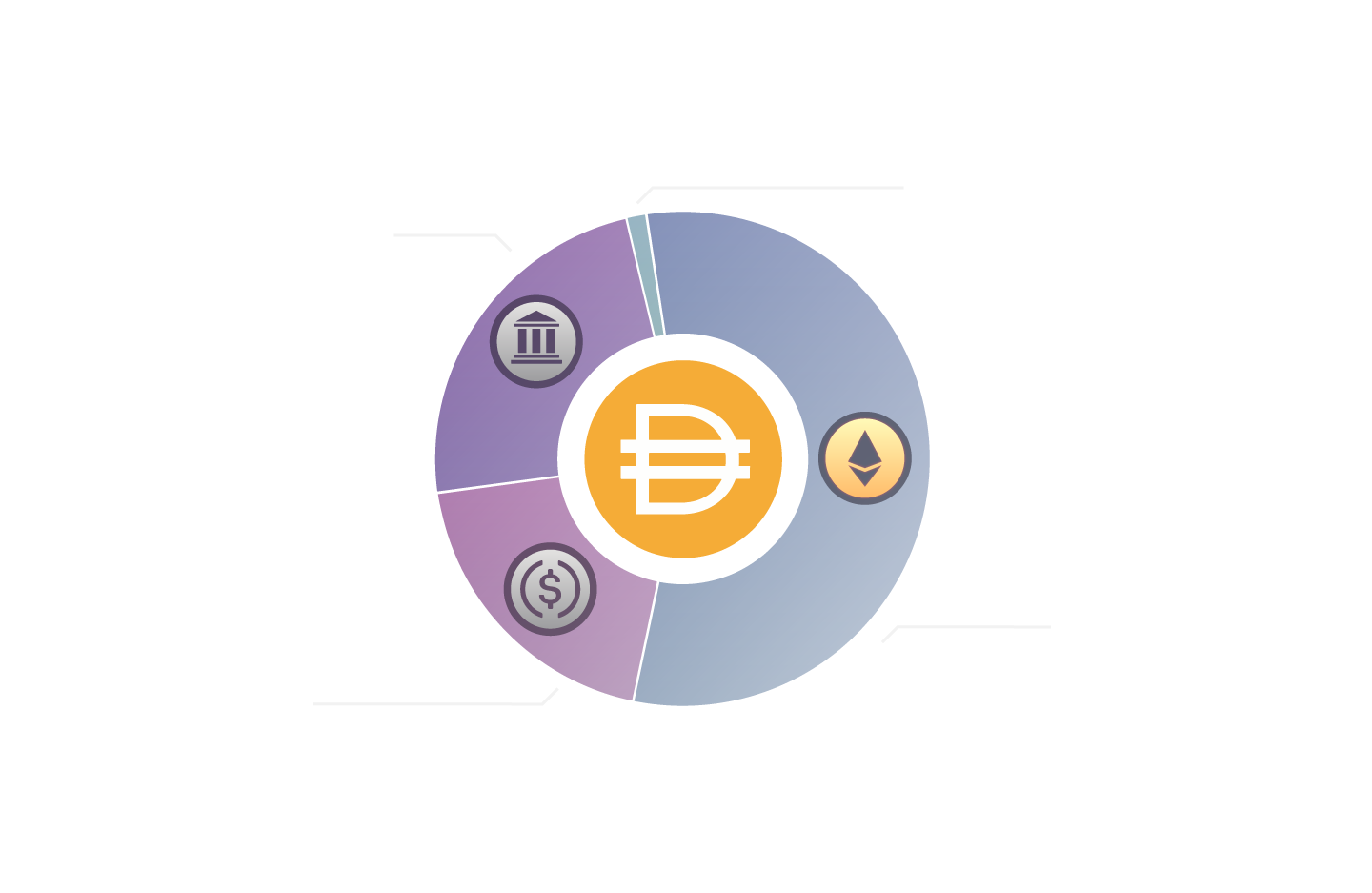
Crypto-collateralized stablecoins are a more transparent, decentralized option, and these qualities help eliminate certain risks. They maintain a fiat peg through crypto asset reserves. As crypto market volatility influences the total value of these reserves, these stablecoins are overcollateralized, sometimes up to 200%! All collateralized assets are viewable on chain, giving users 24/7 access to the real composition of their stablecoins.
The most notable example in this category is Sky’s USDS, the successor to MakerDAO’s Dai (DAI), the original crypto-collateralized stablecoin, after MakerDAO rebranded to Sky in 2024. For a purer take on decentralization, Liquity’s LUSD is backed exclusively by overcollateralized ETH deposits.
Considerations:
-
Collateral Valuation: A stablecoin’s reserves typically consist of crypto, other stablecoins, and even other asset classes. For example, USDS is backed by ETH, stablecoins, real-world assets like US Treasuries, and several other minor components. To mitigate the risks of this diverse range of assets, USDS is overcollateralized (at the time of writing). Even if the ETH price was to crash by 20%, USDS would still have enough collateral to cover its tokens. However, further price volatility across its range of assets could begin to erode the peg.
-
Counterparty Risk: Reliance on multiple asset classes means there’s a higher chance one of the assets will experience difficulty and affect the value of your holdings. However, you only have fractional exposure to the impact of each individual risk. -
Governance Risk: This type of stablecoin and its treasury are managed by a decentralized group of governance voters. This means there are risks of human error, or possible governance capture.
3. Algorithmic Stablecoins
These tokens attempt to maintain their peg by automatically balancing their own supply instead of holding full collateral: an onchain algorithm removes tokens from circulation when the market price falls below the peg, and mints new ones when it rises above. On paper, this promises a stablecoin free of banks and collateral. In practice, the pure version of this design has failed, catastrophically.
The defining example is Terra’s UST, whose algorithm let holders always swap 1 UST for $1 worth of Terra’s volatile LUNA token. In May 2022, mass UST selling forced the algorithm to mint enormous amounts of LUNA, crashing its price and triggering yet more selling: a death spiral that erased around $40 billion in a matter of days. UST never recovered its peg.
Surviving projects have abandoned the pure model. Frax, once partly algorithmic, moved to 100% collateralization in 2023; its current stablecoin, frxUSD, is backed by reserves including tokenized US Treasury funds, while FRAX now serves as the protocol’s governance token.
A distinct modern category has emerged from the rubble: hybrid or ‘synthetic dollar’ designs like Ethena’s USDe, which holds crypto collateral plus offsetting trading positions that cancel out price moves (a ‘delta-neutral’ hedge). These are collateralized, but in a novel way, with their own risks, such as reliance on the exchanges holding those positions, and on market conditions that keep the hedge profitable.
Considerations:
-
Death Spiral Risk: A pure algorithmic peg depends on continued market confidence. When confidence breaks, the supply mechanism can amplify the crash instead of stopping it, with no collateral left to redeem.
-
Highly Technical: You need to understand what actually backs the token (and under what conditions that backing could fail) to build confidence and risk/reward awareness.
-
Emergent Tech Risk: Hybrid and synthetic designs are largely untested through a full market cycle. Only use tokens with several smart contract audits by top-level auditors, and remember that audits can’t protect against a flawed economic design.
Choosing a Stablecoin
What is the best stablecoin to hold? As with everything DeFi, the answer to that question depends on your needs, values, and risk tolerance.
Here’s a quick refresher on each category:
-
💵 Fiat-backed: The traditional approach, the closest you’ll come to holding fiat on chain.
-
Values: Conventionality, institutional trust.
-
Risks: Opaque collateral backing, ability for provider to freeze funds.
-
-
🔗 Crypto-collateralized: A balanced, crypto-native approach, spreading collateral risk across multiple asset classes.
-
Values: Diversification, transparency, progression.
-
Risks: Crypto market volatility, dependence on other assets.
-
-
🔃 Algorithmic: The experimental frontier: pure designs have failed catastrophically, and modern hybrids are still unproven.
-
Values: Innovation, capital efficiency, progression.
-
Risks: Death spirals, flawed economic designs, smart contract bugs.
-
As always, the best way to learn about something is to try it. You might even decide to hold a variety of stablecoins.
And remember, not all stablecoins in each category are created equal! Do your own research before interacting with any new token.
We hope you’ve enjoyed this entry in the Explorer’s Handbook: ‘Understanding Stablecoins’.
Don’t forget to collect this entry if you want to own a copy for easy reference on your travels, or to support future content at Bankless Academy. Safe travels, Explorer!
Frequently Asked Questions
What are the most popular stablecoins?
Looking at the leading stablecoins by market cap gives an idea of the current market preference, but this isn’t guidance on how you should position yourself, or how safe that position would be.
Here’s a realtime list of top stablecoins by market cap: https://defillama.com/stablecoins
Cryptocurrency users often refer to the ‘Lindy Effect’ when choosing investment options. This concept says that the longer something has existed, the more we can expect it will continue to exist. Seventeen years of cryptocurrency history have shown this to only be true on occasion.
Where can I buy stablecoins?
Centralized Exchanges (CEXs) offer popular fiat-backed stablecoins (and typically their own branded stablecoin), other types of stablecoin are often missing.
Visit a Decentralized Exchange (DEX), or use a direct wallet on-ramp service like ‘MetaMask Buy’, to acquire crypto-collateralized and algorithmic tokens. Check out our lesson on Decentralized Exchanges to learn more about peer-2-peer marketplaces.
How can I earn interest on stablecoins?
Some CEXs offer yield by just holding stablecoins on their platform, funded by a share of platform profits to incentivize platform use. Note for US readers: under the GENIUS Act, regulated stablecoin issuers themselves may not pay interest to holders: yield comes only from third-party platforms, and availability varies by jurisdiction.
You can also earn interest in DeFi, with trustless lending and borrowing platforms. These platforms connect lenders and borrowers, managing risk through onchain collateral and smart contracts. Stablecoin lenders can earn annual returns far higher than available in the traditional banking sector, but where there’s reward, there’s risk!
The lending and borrowing topic deserves its own Bankless Academy entry. If you’re already interested in learning more you can research platforms like Aave.com and Curve.fi.
What happens if a stablecoin loses its peg?
The market price of any stablecoin drifts slightly with the ebb and flow of trading. For major stablecoins, this is usually just a few hundredths of a cent above or below $1. These tiny deviations are quickly closed by traders taking advantage of arbitrage opportunities.
However, there are cases where a stablecoin loses its peg beyond safe, temporary ranges. This effect isn’t necessarily permanent (USDC, March 2023), but it can be (Terra, May 2022).
Some fiat-backed stablecoin issuers, like USDC, offer 1:1 redemption from their stablecoin to regular fiat through their website. Whether this remains true during times of crisis is another story.
Author
Tetranome is the Project Champion at Bankless Academy, focusing on user experience, UI, design, and platform curriculum.
Editor
Trewkat is a writer and editor at BanklessDAO. She’s interested in learning about crypto and NFTs, with a particular focus on how best to communicate this knowledge to others.
Patron
This unsponsored article is part of your free Bankless Academy education. Collect the article to support future content!